Independent guide to Florida universities for Brazilian and international students — real costs, verified merit scholarships, admission step by step
English · Português

Orlando, Florida · Public university

University of Central Florida (UCF) for Brazilian students

Tuition, acceptance rate, scholarships with conservative numbers and the admission process step by step — in dollars and Brazilian reais — updated 2026-08-15. Este guia em português →

Tuition/year
$22,467
Total cost/year
$36,067
In reais (R$)
R$ 186,106
Talk to an advisor

Reply within one business day. No obligation.

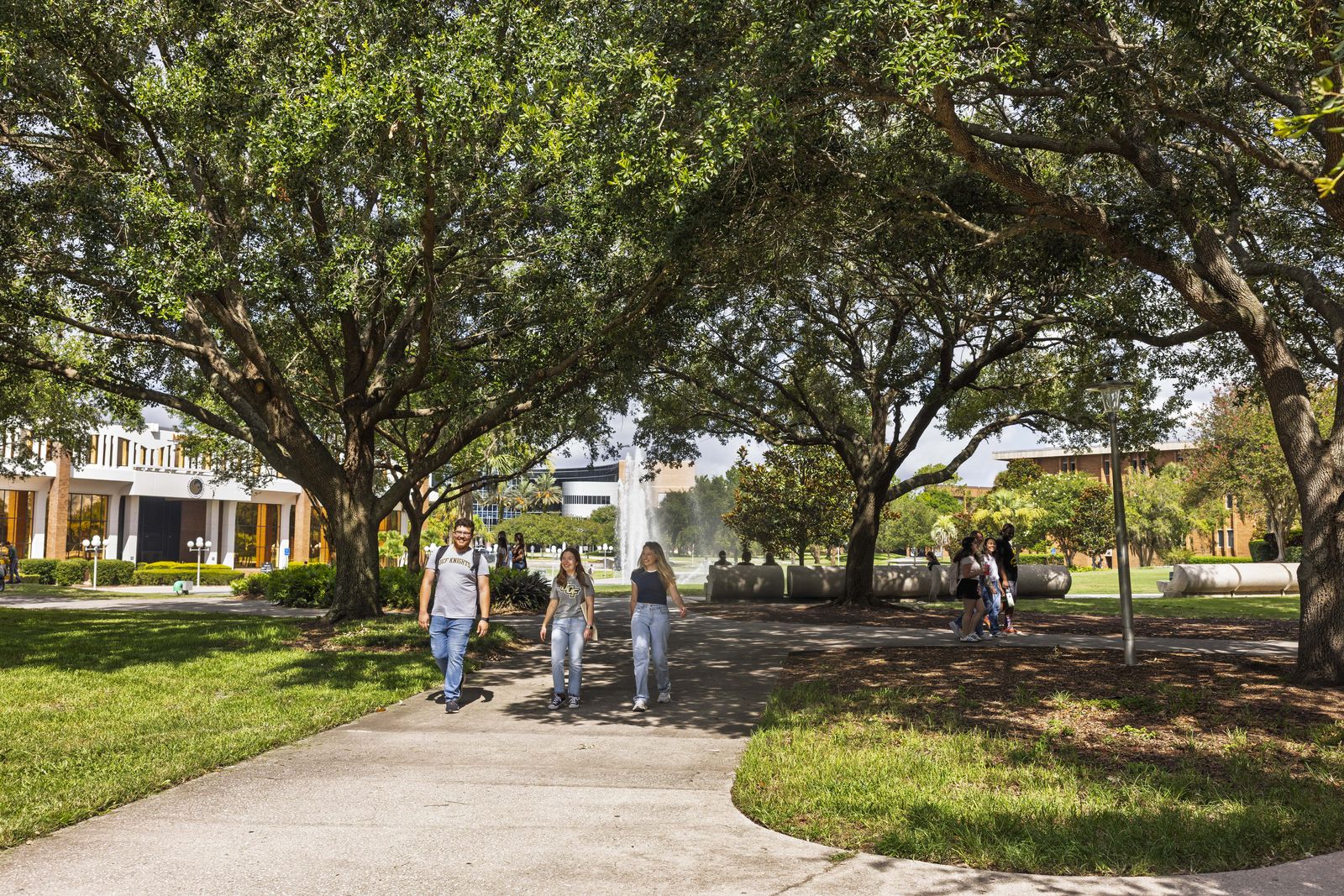
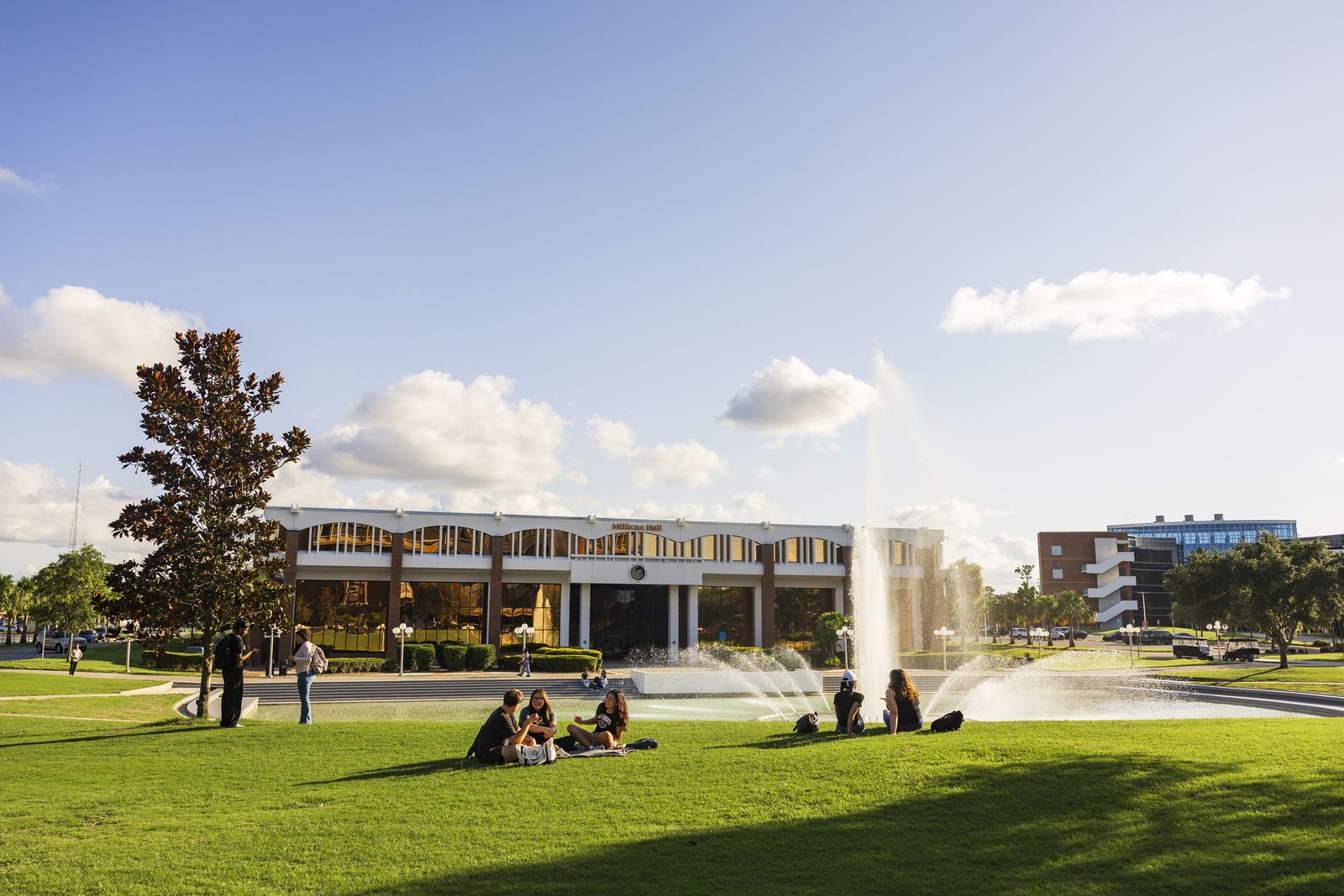
Students sitting on the lawn by the Reflecting Pond, with the fountain and Millican Hall behind, on UCF's main campus in Orlando
Photo: University of Central Florida

Profile

University of Central Florida by the numbers

The figures below come from the US Department of Education's public databases and from University of Central Florida's own Common Data Set. They let you gauge the size of the institution, the real level of competition and the odds of finishing on time.

Acceptance rate
40%
Undergraduate students
59,552
Total students
69,713
International students
3.6%
Student-faculty ratio
28:1
Graduation rate (6 years)
78%
Founded
1963
Campus setting
Suburban, east Orlando

Federal data (NCES) covers UCF as a whole, including Rosen College, Lake Nona and the downtown Orlando campus. No official main-campus-only breakdown exists.

Admission

University of Central Florida acceptance rate: how hard it is to get in

University of Central Florida admits 40% of applicants, according to College Navigator, the US Department of Education's public database.

The middle half of admitted students scored between 1220 and 1350 on the SAT and between 25 and 30 on the ACT. The average high-school GPA of admitted students is 4.18; the published minimum for international applicants is 3.0.

In practice, for a Brazilian applicant: a converted transcript near the average GPA and an SAT inside the range put you in the typical admitted group. Below that, admission is still possible, but merit aid gets harder.

Costs

University of Central Florida tuition and total cost per year

Tuition at University of Central Florida for international students is $22,467 a year. With housing, meals and health insurance the estimated total is $36,067 — about R$ 186,106 at R$ 5.16 to the dollar (2026-08-15), verified on 2026-08-15.

ItemAnnual estimate (USD)Approx. in R$
Tuition (out of state)$22,467R$ 115,930
Housing and meals$11,000R$ 56,760
Health insurance$2,600R$ 13,416
Estimated total$36,067R$ 186,106

Estimates for 2026–2027, verified on 2026-08-15. Converted at R$ 5.16 to the dollar (2026-08-15). Books, transport and course fees vary.

Annual cost breakdown: Tuition $22,467, Housing and meals $11,000, Health insurance $2,60062.3%30.5%
Tuition · $22,467Housing and meals · $11,000Health insurance · $2,600

Scholarships

Scholarships at University of Central Florida: conservative numbers

Merit scholarships: students have received between 5% and 30% of tuition (conservative estimate, 2026–2027; verified on 2026-08-15). Typical conditions: Merit scholarships with SAT 1250+ and GPA 3.5+. The real amount depends on your profile — we never promise percentages.

Our rule is simple: we would rather you plan with conservative numbers and be surprised for the better — never the other way round. Studying in the United States is not free for anyone.

International aid

Scholarships for international students at University of Central Florida

Only awards the university itself describes are listed, with the requirements it publishes. Where the official page does not say whether international students may apply, the table says "not stated" — ask before counting on the money.

Pegasus Gold, Silver and Bronze Scholarships (Freshman Pegasus Awards)

Amount per year: UCF does not publish per-tier amounts. The Tuition & Aid page says merit scholarships for incoming FTIC students are distributed over four years and range from $6,000 to $30,000 for Florida residents and up to $50,400 for non-Florida residents. Non-residents receive the award as a waiver of the out-of-state tuition portion; it does not pay resident tuition or other fees.

Requirements: First-year (high school) applicant admitted for summer or fall; 'awarded to exceptional high school students who are accepted for a summer or fall semester by Undergraduate Admissions'. Competitive: fewer than 20 percent of students receive an offer. Complete application (fee, SPARK Form, SAT/ACT/CLT scores) by the Early Action deadlines.

International: Not stated

Renewal: Minimum 12 UCF credit hours each fall and spring, 24 completed hours per year, 3.0 UCF cumulative GPA at the end of each spring; maximum 8 semesters; FAFSA not required.

Deadline: Early Action: application by Oct. 15 and materials by Nov. 15 (summer/fall entry). 'Scholarship funding for FTIC students is usually exhausted by mid-January'.

How to apply: Automatic: 'There is no separate application for this scholarship program. Students who apply for admission to UCF for summer or fall terms are automatically considered.' Stacking: any combination of UCF-sponsored non-resident waiver awards covers up to the waiver amount or the non-resident fee amount, whichever is less.

Pegasus Scholarship Waiver / Knights Achievement Scholarship Waiver

Amount per year: Waiver of the out-of-state tuition portion, 'up to the full amount offered by Undergraduate Admissions as long as it does not exceed the non-resident fee amount'. The per-semester maximum is stated in the award letter.

Requirements: 'These scholarships are awarded to entering out of state high school graduates by Undergraduate Admissions to recognize outstanding academic performance.'

International: Not stated

Renewal: 12 UCF credit hours per term, 24 hours per year, 3.0 UCF GPA at the end of each spring, maximum 8 semesters.

Deadline: Same Early Action deadlines (Oct. 15 and Nov. 15).

How to apply: Automatic with the admission application.

Provost Scholarship (Freshman Provost Award)

Amount per year: Amount not published.

Requirements: Florida residents only, with outstanding academic credentials; fewer than 10 percent of the entering class. Includes priority consideration for The Burnett Honors College.

International: No

Renewal: 12 hours per term, 24 per year, 3.0 UCF GPA, maximum 8 semesters.

Deadline: Early Action (Oct. 15 and Nov. 15).

How to apply: Automatic with the application.

National Merit Scholarship (UCF Scholars Program)

Amount per year: Amount not published on the page; cannot exceed Cost of Attendance when combined with other resources.

Requirements: Designation as a National Merit Scholar (PSAT/NMSQT-based program administered through U.S. high schools). Florida residents receive it through the Benacquisto Scholarship Program.

International: Not stated

Renewal: 12 hours per term, 24 per year, 3.0 UCF GPA, maximum 8 semesters.

Deadline: Not stated; contact scholarsprogram@ucf.edu.

How to apply: Automatic via Undergraduate Admissions; designated students should contact The Scholars Program.

Florida Linkage Institutes tuition waiver (Florida-Brazil Institute) — ended

Amount per year: Waiver of the out-of-state tuition portion (in-state rate). ENDED: Florida HB 905 (2026, Chapter 2026-66) repealed the in-state residency exemption effective July 1, 2026.

Requirements: Certification by the country's Linkage Institute (UCF's Student Account Services waivers page still lists the 'Florida-Brazil Institute' among the 11 institutes).

International: No

Renewal: Not applicable — program ended.

Deadline: Not applicable.

How to apply: Not applicable. UCF's page still describes the old procedure (send the institute's letter to saswaivers@ucf.edu), but the statutory benefit no longer exists.

UCF Global Hardship Tuition Waiver

Amount per year: Amount not published; applied toward the out-of-state portion of tuition; 'it is not possible to receive full tuition coverage'. Generally received only once.

Requirements: Enrolled undergraduate international student with documented unexpected, temporary financial hardship. Not an entry award.

International: Yes

Renewal: Generally one time only; exceptions for extenuating circumstances.

Deadline: Notified by Knights email about one month before fall and spring semesters.

How to apply: UCF Global application form after notification; committee reviews case by case.

UCF Global Pathway Program scholarship (Latin America and Caribbean)

Amount per year: 'Potential 1-year scholarship'; amount not published.

Requirements: Latin American and Caribbean students who complete the UCF Global Pathway program and continue into degree-seeking undergraduate studies.

International: Yes

Renewal: One year; no further details.

Deadline: Not stated.

How to apply: Not stated; through UCF Global Pathway Programs.

Access 2 Opportunities (A2O) — college and departmental scholarships

Amount per year: Varies; 'over 200 scholarships' / 'hundreds of scholarships offered by the university'.

Requirements: One-time general application in A2O; each award has its own criteria. OSFA says it 'does not award scholarships for non-U.S. citizens. However, the office lists various scholarship opportunities for non-US citizens on the Scholarship page.'

International: Not stated

Renewal: Depends on the award.

Deadline: 'The peak time to apply for scholarships is January through May for the upcoming school year.'

How to apply: Form: A2O general application.

Need-based aid

There is no federal or institutional need-based aid for international first-year students: UCF states it does not award scholarships to non-U.S. citizens, and federal aid requires citizenship or residency. What exists is merit at admission, departmental awards and, at graduate level, assistantships.

Scores

What University of Central Florida asks of Brazilian applicants

RequirementReference
SAT (25th–75th percentile)1220 – 1350
ACT (25th–75th percentile)25 – 30
Average GPA of admitted students4.18
Minimum GPA3.0
Minimum TOEFL (1–6 band scale, in force since 21 January 2026)4 · tests taken before 21 January 2026: 80
Minimum IELTS6.5
Minimum Duolingo120
SAT/ACT policySAT or ACT required

UCF accepts TOEFL iBT 80 on the legacy scale, or 4 on the 1–6 scale in use since January 2026, IELTS 6.5 and Duolingo 120. It does not accept PTE, TOEFL Essentials, Cambridge or iTEP. The test is waived with SAT Reading and Writing 520, ACT English 20 or CLT 42. Verified on 2026-09-07.

SAT range of admitted students: 1220 at the 25th percentile and 1350 at the 75th12201350average 1260
Half of admitted students fall inside the highlighted range. Landing below it does not rule you out, but it weighs on merit aid.

How your Brazilian transcript is read

The ENEM plays no part in the review. The university converts your secondary-school grades onto the American 0 to 4 scale, and that number is what appears as your GPA. Averages between 7 and 8 usually land near 3.0; above 9, near 4.0. The conversion is done either by the university itself or by a credential evaluation service, and the transcript has to be translated by a sworn translator.

Tests

Admission tests at University of Central Florida

Admitted-student profile according to U.S. News & World Report

U.S. News publishes the range covering the middle half of admitted students, not an average. Use the range as a gauge of competitiveness (2026 data).

ItemReference
SAT (25th–75th percentile)1200 – 1350
ACT (25th–75th percentile)25 – 29
Average high-school GPA3.9
Acceptance rate45%

Source: U.S. News & World Report

Accepted English tests and minimum scores

TestMinimum scoreNote
TOEFL iBT (new 1–6 scale, tests from January 2026)4Minimum for international first-year applicants whose native language is not English; page says 'a minimum qualifying score of 4 (iBT January 2026 and later)'.
TOEFL iBT (legacy 0–120 scale, tests before January 2026)80'80 (iBT prior to January 2026)'. TOEFL institution code 5233.
IELTS Academic6.5Overall band 6.5; no sub-score minimums published.
Duolingo English Test120'a minimum qualifying score of 120 on the Duolingo English Test'.
SAT – Evidence-Based Reading and Writing section520Satisfies English proficiency: '520 on the Evidence-Based Reading and Writing section -or- 480 on the Critical Reading section of the SAT' (480 applies to the old SAT). Since SAT/ACT/CLT is already required of every freshman, this is the simplest route.
ACT – English section20'a minimum qualifying score of 20 on the English section of the ACT'.
CLT – Verbal Reasoning + Grammar/Writing42'a minimum qualifying score of 42 on the Verbal Reasoning + Grammar/Writing section of the CLT'. CLT accepted only if taken July 1, 2023 or later.
TOEFL Essentialsnot acceptedNot on the list. Page states: 'Any tests not included above are not endorsed by UCF.'
PTE Academicnot acceptedNot listed among accepted tests for first-year applicants (checked 2026-09-07).
Cambridge English (B2 First / C1 Advanced / C2 Proficiency)not acceptedNo Cambridge English exam appears on the proficiency list. UCF mentions Cambridge AS/A level and AICE only as academic credentials, not as English proof.
iTEPnot acceptedNot listed (checked 2026-09-07).
ELSnot acceptedNot listed. The in-house alternative is completing UCF Global's IEP/OEP level 8 or higher with a grade of B or better.
Waiver: country where English is the only official languagewaived'proving they are from a country where English is the only official language'. Does not apply to Brazilians.
Waiver: 4 years of English at a U.S. or U.S.-accredited high schoolwaived'establishing that four years of English were or will be completed by the time of enrollment at a high school in the United States or U.S. territory or at a high school accredited by an institutional accreditor recognized by the U.S. Department of Education'. US-accredited American schools in Brazil may qualify; confirm with uainternational@ucf.edu.
Waiver: ENC 1101 and ENC 1102 (or equivalent) with a B or higher at an accredited U.S. collegewaivedAlso: UCF Global IEP/OEP level 8 with a B; GAA 10210 (EAS 2) with a C; EAP 2851 with a C or placement into ENC 1101; or an onsite assessment by UCF Global faculty.

Cambridge English (B2 First, C1 Advanced, C2 Proficiency) appears in the table when the university accepts it. If it is absent, the official page does not list it — do not send a Cambridge certificate in place of the TOEFL without confirming with admissions.

SAT and ACT

The SAT, ACT or CLT is required of every first-year applicant, international included; UCF publishes no admission minimum. The university superscores both the SAT and the ACT. To compete for merit scholarships, the complete application with official scores must arrive by the Early Action deadline. Verified on 2026-09-07.

Is your score below 4 (1–6 scale) on the TOEFL or 120 on the Duolingo test? That does not end the plan — our live prep courses with a teacher exist to close exactly that gap.

Majors

All majors at University of Central Florida

UCF is known for three areas that lean on the region's economy. Engineering and computer science lead, anchored by CREOL, the optics and photonics center, and by a long tradition in modeling and simulation tied to Orlando's defense and training cluster. Hospitality and tourism sit at Rosen College, on its own campus beside the hotel and theme-park district. Digital media and games have FIEA, a graduate program in downtown Orlando built for students heading into studios. Beyond that, the list of majors is long: nursing, psychology, business, education, health sciences. The medical school is in Lake Nona, on yet another campus.

There are 117 majors, grouped by the school that offers them, each with the degree code the application form uses. Search by name, or filter by school or STEM.

The 26 majors marked STEM qualify for an extra 24 months of work authorisation on top of OPT — up to 36 months working in the United States after graduation. If you plan to stay, that designation matters more than the name of the degree.

117 majors

College of Arts and Humanities20

Art
BA
Studio Art
BFA
Bachelor of Design in Architecture
BDes
Music Education
BME
Writing and Rhetoric
BA
French and Francophone Studies
BA
Latin American Caribbean and Latinx Studies
BA
Philosophy
BA
History
BA
Humanities and Cultural Studies
BA
Integrated Humanities
BA
Integrated Humanities
BS
Spanish
BA
English
BA
Emerging Media
BFA
Music
BA
Music: Performance
BM
Religion and Cultural Studies
BA
Theatre
BA
Theatre
BFA

College of Community Innovation and Education28

Public Administration
BA
Public Administration
BS
Environmental Science
BSSTEM
Early Childhood Development and Education
BS
Exceptional Student Education
BS
Career and Technical Education
BS
Environmental Studies
BSSTEM
Integrative General Studies
BGS
Interdisciplinary Studies
BA
Interdisciplinary Studies
BS
Legal Studies
BA
Legal Studies
BS
Teacher Education
BS
Emergency Management
BA
Emergency Management
BS
Nonprofit Management
BA
Nonprofit Management
BS
Health Informatics and Information Management
BS
Criminal Justice
BA
Criminal Justice (BA) - Professional Track
Criminal Justice
BS
Criminal Justice (BS) - Professional Track
Secondary Education
BS
Leadership
BA
Leadership
BS
Elementary Education
BS
Sustainability
BA
Sustainability
BS

College of Engineering and Computer Science11

Computer Science
BSSTEM
Materials Science and Engineering
BSSTEM
Aerospace Engineering
BSAESTEM
Environmental Engineering
BSVESTEM
Civil Engineering
BSCESTEM
Computer Engineering
BSCpESTEM
Construction Engineering
BSConE
Industrial Engineering
BSIESTEM
Electrical Engineering
BSEESTEM
Mechanical Engineering
BSMESTEM
Information Technology
BSSTEM

College of Health Professions and Sciences9

Health Services Administration
BS
Kinesiology
BS
Health Sciences
BS
Communication Sciences and Disorders
BS
General Health Studies
BS
Interdisciplinary Healthcare Studies
BS
Health Information Management
BS
Health Informatics
BS
Social Work
BSW

College of Medicine5

Molecular and Cellular Biology
BSSTEM
Biotechnology
BSSTEM
Biomedical Sciences
BSSTEM
Medical Laboratory Sciences
BSSTEM
Molecular Microbiology
BSSTEM

College of Nursing2

Nursing
BSN
Nursing RN
BSN

College of Optics and Photonics1

Photonic Science and Engineering
BSPSE

College of Sciences26

Anthropology
BA
Biology
BSSTEM
Film
BA
Film
BFA
Data Science
BSSTEM
Political Science
BA
Actuarial Science
BSSTEM
Forensic Science
BS
Integrated Sciences and Technology
BS
Social Sciences
BS
Communication
BA
Communication and Conflict
BA
Statistics
BSSTEM
International and Global Studies
BA
Physics
BASTEM
Physics
BSSTEM
Journalism
BA
Mathematics
BSSTEM
Digital Media
BA
Media Production and Management
BA
Psychology
BS
Advertising / Public Relations
BA
Chemistry
BASTEM
Chemistry
BSSTEM
Sociology
BA
Sociology
BS

Miller College of Business9

Management
BSBA
Accounting
BSBA
Economics
BS
Business Economics
BSBA
Finance
BSBA
Risk Management and Insurance
BSBA
Marketing
BSBA
Real Estate
BSBA
Integrated Business
BSBA

Rosen College of Hospitality Management6

Entertainment Management
BS
Event Management
BS
Lodging and Restaurant Management
BS
Hospitality Management
BS
Theme Park and Attraction Management
BS
Senior Living Management
BS

Graduate

Graduate study at University of Central Florida

Master's study here usually follows one of two routes. One is applying after graduation, with a separate application, test scores and letters. The other is an accelerated format, where an undergraduate starts taking graduate coursework in the final year and finishes both degrees in less time. Not every major offers this and the rules vary by department. If a master's is already part of the plan, choose the major with that in mind and confirm directly with the department before applying.

Close to 11.6% of University of Central Florida's graduate students come from outside the United States. It is a far more international room than the undergraduate one, and that changes the experience: almost everyone beside you also arrived recently.

There are 101 programs open to international students.

101 programs

ProgramSTEMGRE or GMAT requiredIntake
Barry S. Miller College of Business8
Accounting MSANoFSpSu
Business Administration MBANoFSpSu
Business Analytics MSNoFSpSu
Economics MS——
FinTech MSNoFSpSu
Management MSM—FSpSu
Real Estate MSRENo—
Sport Business Management MSBMNoFSpSu
College of Arts and Humanities11
Creative Writing MFANoFSpSu
Emerging Media MFANoFSpSu
English MANoFSpSu
English, Rhetoric and Composition MANoFSpSu
History MANoFSpSu
Music MANoFSpSu
Spanish MANoFSpSu
Teaching English to Speakers of Other Languages (TESOL) MANoFSpSu
Theatre MA—FSpSu
Theatre MFANoFSpSu
Themed Experience MSNoFSpSu
College of Community Innovation and Education24
Applied Learning and Instruction MA——
Career and Workforce Education MANoFSpSu
Counselor Education MANoFSpSu
Counselor Education MEdNoFSpSu
Criminal Justice MSNoFSpSu
Early Childhood Development and Education MSNoFSpSu
Educational Leadership MA—FSpSu
Educational Leadership MEdNoFSpSu
Elementary Education MANoFSpSu
Elementary Education MEdNoFSpSu
Emergency and Crisis Management MECMNoFSpSu
Exceptional Student Education K-12 MANoFSpSu
Exceptional Student Education MEdNoFSpSu
Instructional Design and Technology MANoFSpSu
K-8 Mathematics and Science Education MEdNoFSpSu
Marriage, Couple, and Family Therapy MANoFSpSu
Nonprofit Management MNM—FSpSu
Public Administration MPA—FSpSu
Public Policy MPPNoFSpSu
Reading Education MEdNoFSpSu
Research Administration MRANoFSpSu
Secondary Education MEd—FSpSu
Teacher Education MAT—FSpSu
Urban and Regional Planning MSNoFSpSu
College of Engineering and Computer Science23
Aerospace Engineering MSAENoFSpSu
Biomedical Engineering MSBMENoFSpSu
Civil Engineering MSNoFSpSu
Civil Engineering MSCENoFSpSu
Computer Engineering MSCpENoFSpSu
Computer Science MS—FSpSu
Computer Vision MSNoFSpSu
Cyber Security and Privacy MSNoFSpSu
Data Analytics MSNoFSpSu
Digital Forensics MSNoFSpSu
Electrical Engineering MSEENoFSpSu
Engineering Management MSEM—FSpSu
Environmental Engineering MSNoFSpSu
Environmental Engineering MSEnvENoFSpSu
Environmental Engineering MSEnvE, Accelerated BS to MSEnvENoFSpSu
Industrial Engineering MSNoFSpSu
Industrial Engineering MSIENoFSpSu
Materials Science and Engineering MSMSENoFSpSu
Mechanical Engineering MSMENoFSpSu
Modeling and Simulation MSNoFSpSu
Robotics and Autonomous Systems MSRASNoFSpSu
Systems Engineering, MSSENoFSpSu
Travel Technology and Analytics MSYesFSpSu
College of Graduate Studies3
Interdisciplinary Studies MANoFSpSu
Interdisciplinary Studies MSNoFSpSu
Nanotechnology MSNoFSpSu
College of Health Professions and Sciences8
Athletic Training MATNoFSpSu
Communication Sciences and Disorders MANoFSpSu
Health Administration MHANoFSpSu
Health Care Informatics MS, Professional Science Master'sNoFSpSu
Health Promotion and Behavioral Science MS——
Kinesiology MSNoFSpSu
Public Health MPHNoFSpSu
Social Work MSW—FSpSu
College of Medicine2
Biomedical Sciences MS—FSpSu
Biotechnology MSNoFSpSu
College of Nursing1
Nursing MSN—FSpSu
College of Optics and Photonics1
Optics and Photonics MS—FSpSu
College of Sciences18
Anthropology MANoFSpSu
Biology MSNoFSpSu
Chemistry MSNoFSpSu
Clinical Psychology MAYesFSpSu
Clinical Psychology MS, Master Along the Way Track——
Communication MANoFSpSu
Digital Media MANoFSpSu
Feature Film Production MFANoFSpSu
Forensic Science MS——
Human Factors and Cognitive Psychology MA, Master Along the Way Track——
Industrial and Organizational Psychology MSYesFSpSu
Interactive Entertainment MS—FSpSu
Mathematical Science MSNoFSpSu
Physics MSNoFSpSu
Planetary and Space Sciences MS, Master's Along the Way Track——
Political Science MANoFSpSu
Sociology, Applied MA—FSpSu
Statistics and Data Science MSNoFSpSu
Rosen College of Hospitality Management2
Event Leadership MSNoFSpSu
Hospitality and Tourism Management MS—FSpSu
FSpSuF = fall (August) · Sp = spring (January) · Su = summer (May)No = GRE/GMAT waived · Yes = required · — = confirm with the program

What the graduate programs require

RequirementReference
Minimum TOEFL80
Minimum IELTS6.5
Minimum Duolingo120
Application fee$30
Minimum full-time load9 credit hours per semester

GRE and GMAT

75 of the programs above waive the GRE and GMAT. The rest require the test, and a waiver is only considered for applicants holding a business degree from an AACSB-accredited institution. Work experience does not count towards a waiver.

Graduate documents

Beyond a transcript from every institution you attended, with certified translation, the application asks for a personal statement in English, a professional resume and two reference forms from people who can speak to your academic and professional background. A course-by-course credential evaluation is strongly recommended.

Graduate deadlines

IntakeApplication complete by
Fall intakeJanuary 15 (international; also the fellowship priority date)
Spring intakeJuly 1 (international)

Deadlines

When to do what

IntakeApplication deadlineScholarship deadline
Fall intakeMarch 1, 2027 (recommended; UCF's international first-year table says April 1 — use the earlier date)October 15, 2026 (Early Action; materials by November 15)
Spring intakeSeptember 1, 2026 (Spring 2027; the table says October 1)

A 12-month timeline

  1. 12 to 10 months out — choose the universities and check whether your English score already clears the minimum. If it does not, this is where prep comes in.
  2. 10 to 8 months out — translate the transcript and request the credential evaluation where required. It takes 2 to 6 weeks and is the single biggest source of delay.
  3. 8 to 6 months out — submit the application and pay the $30 fee.
  4. 6 to 4 months out — acceptance letter and proof of funds. The university only issues the I-20 after approving the bank statement.
  5. 4 to 3 months out — pay the SEVIS fee, complete the DS-160 and book the consular interview. Confirm the fee amounts on the official site: they change.
  6. 3 to 1 month out — consular interview, visa in the passport, flights, insurance and housing.

Documents

What you need to gather

The order below is the order in which University of Central Florida asks for each item. Start with the first two: they depend on third parties and they are what stalls the process.

  1. Complete secondary-school transcript, translated into English by a sworn translator.
  2. English score — TOEFL from 4 (1–6 scale), or Duolingo from 120.
  3. SAT or ACT score, where required and whenever you want to compete for merit aid.
  4. Letter of recommendation from a teacher or coordinator.
  5. Personal statement in English.
  6. Proof of funds — a bank statement showing funds for the first year. It is the document that releases the I-20, and the one most often sent back for correction.
  7. Valid passport and the $30 application fee.

Campus

Campus life and housing

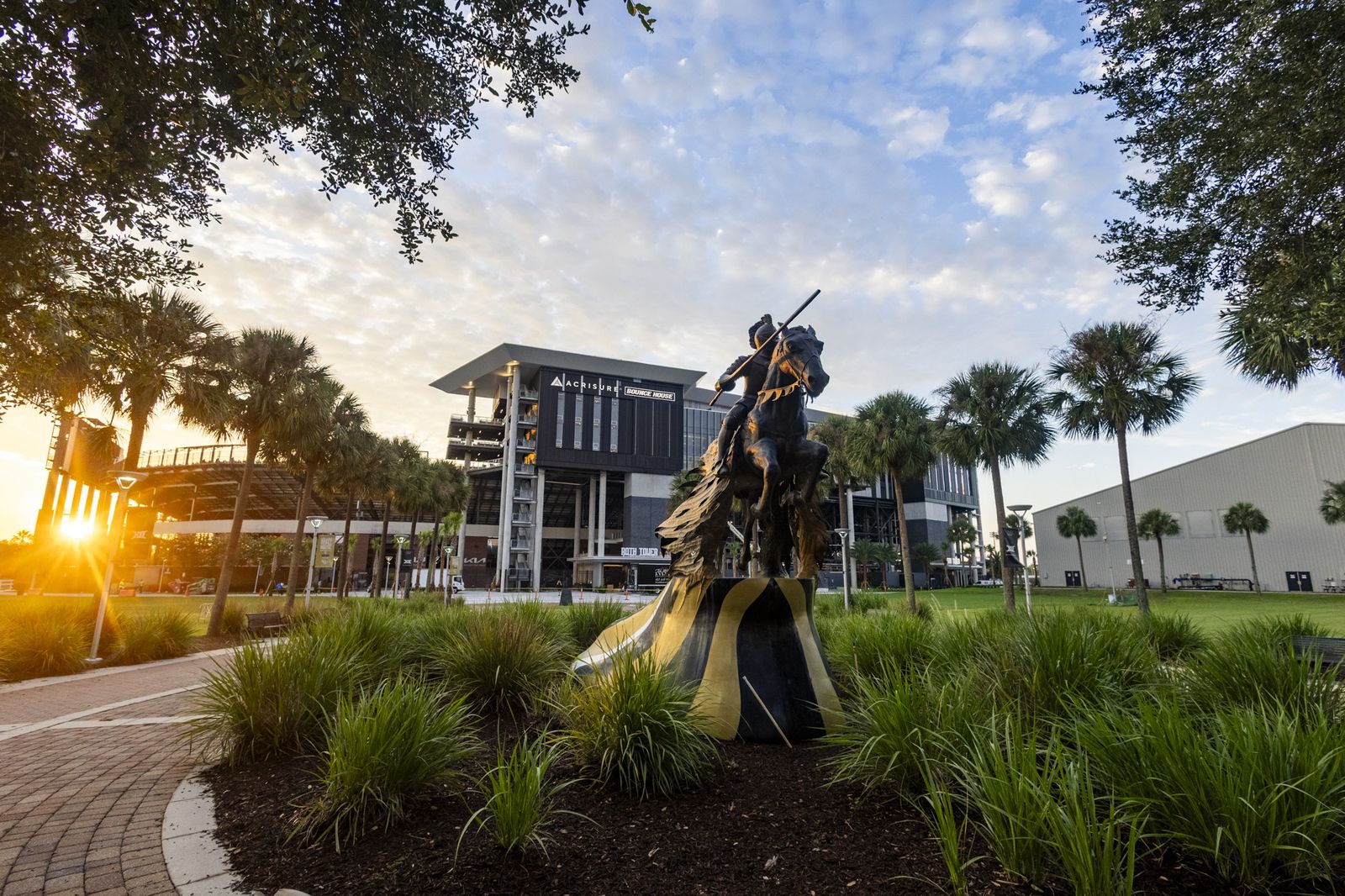
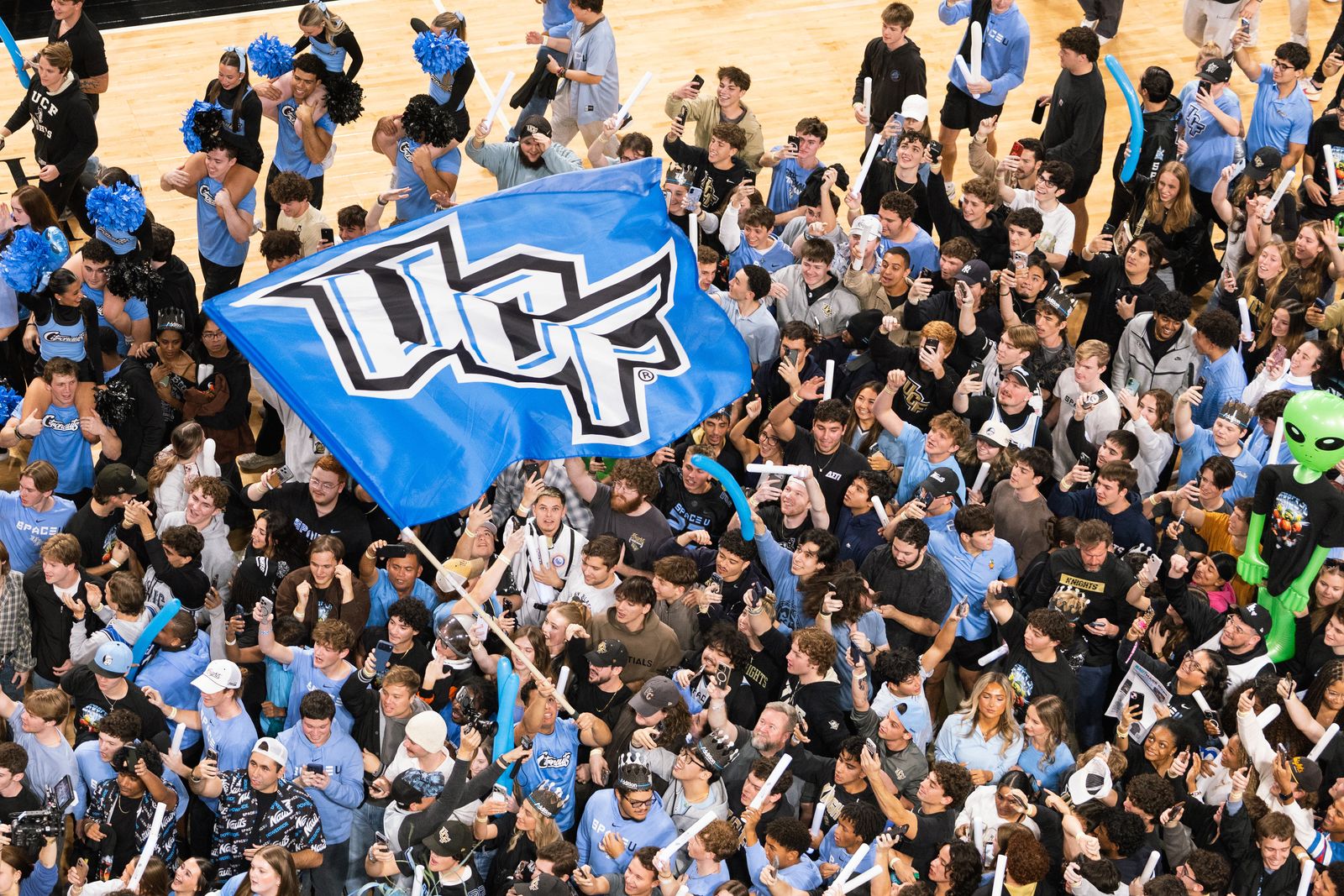
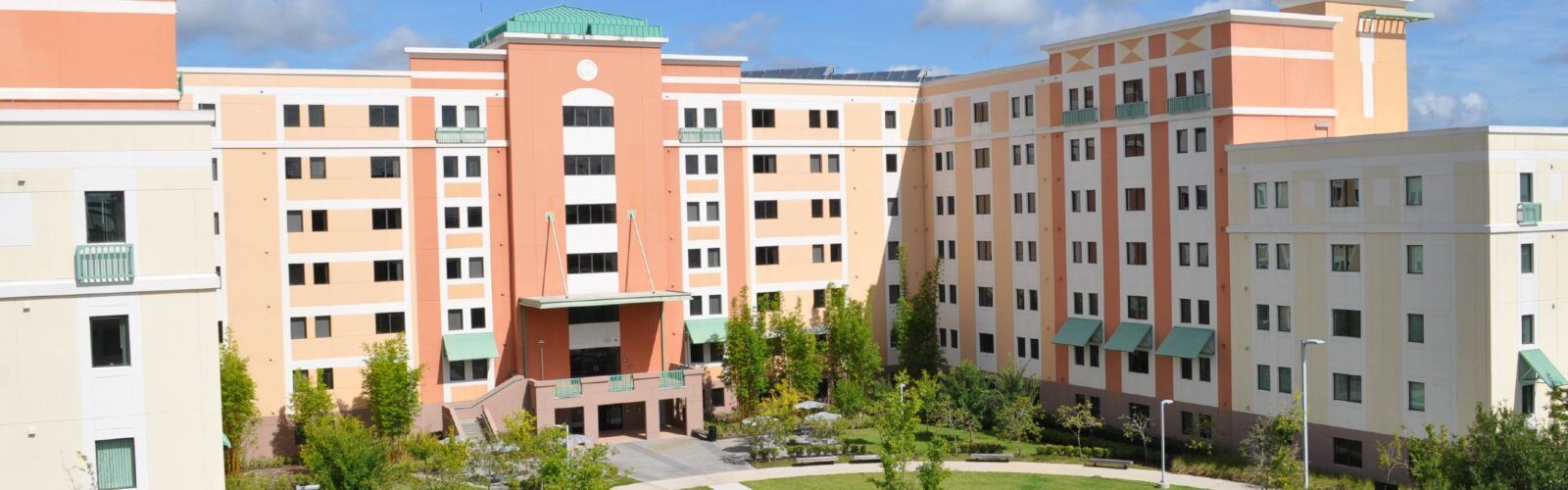
The main campus sits east of Orlando, far from downtown, and it is big in a way you feel in your legs. You can cross it on foot, but it takes time and you will do it in full sun. The layout helps: academic buildings are arranged in rings around the Reflecting Pond, with the library at the center. For the first few weeks you navigate by the pond, and then you stop thinking about it. The football stadium is on campus, and in the fall home Saturdays change the mood of the whole place. The first surprise for most international students is the loneliness of the schedule: there is no fixed class group, everyone builds their own timetable, and friends come from clubs, the gym and the residence halls rather than the classroom.

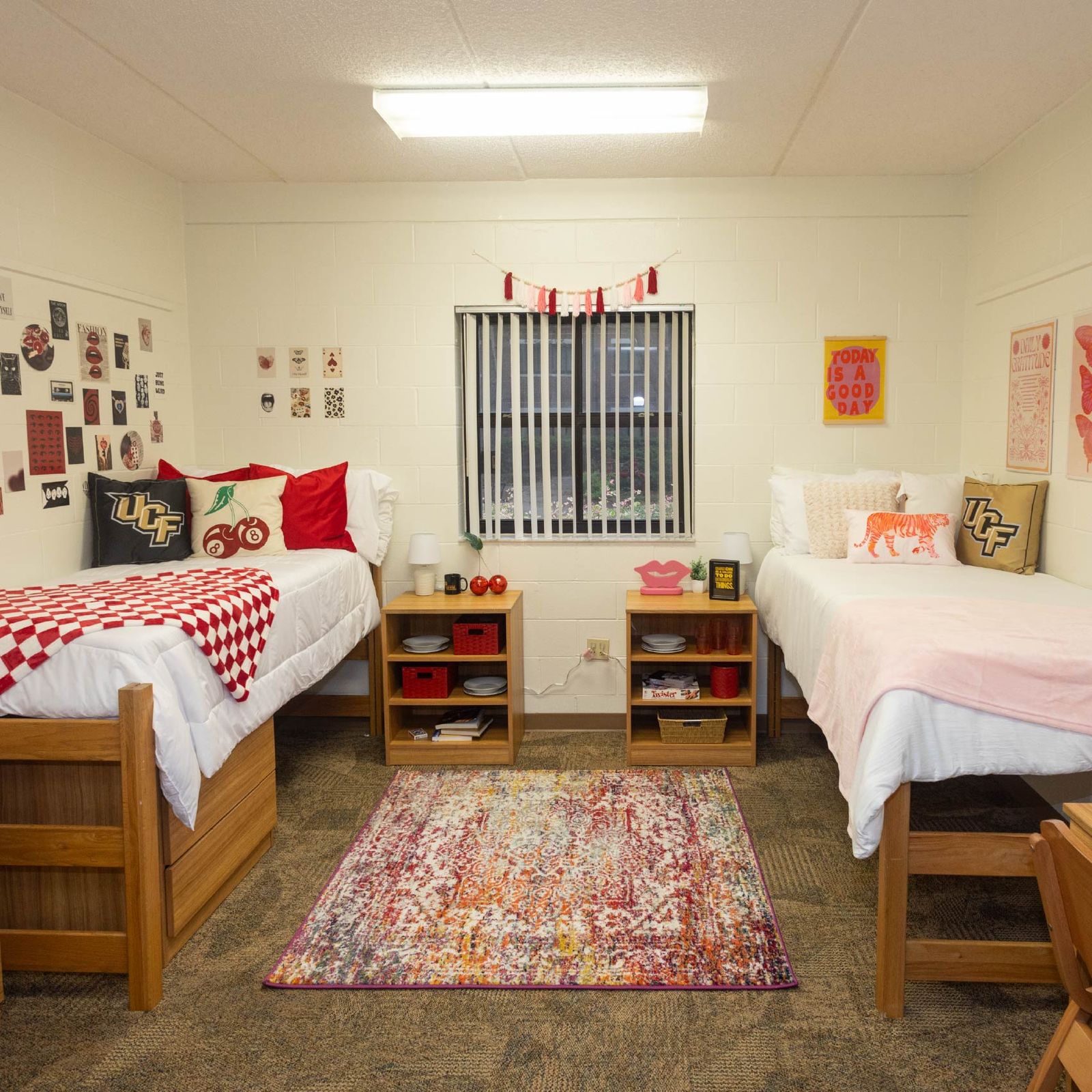
First-year housing works through an online application, and the freshman communities sit on the north side of campus, close to classes. You pick a room type and a building from whatever is still available, so applying early changes the outcome. In practice, almost everyone shares a room in year one, with a bathroom shared between two rooms or down the hall. Pack light: mattresses are twin XL, the air conditioning runs cold year round, and everything else can be bought nearby. A meal plan comes attached to some communities; confirm which rule applies to the building you choose.

Photos: University of Central Florida

There is no requirement to live on campus in the first year, which opens up sharing an apartment off campus — usually cheaper, with transport left to solve.

Photos: University of Central Florida

City

Living in Orlando

Student Orlando is not theme-park Orlando. The campus is ringed by apartment complexes, grocery stores and restaurants that exist because of the university. Most off-campus students live along Alafaya Trail and University Boulevard, a short bus or bike ride from class. Those who want quiet move to Waterford Lakes or Oviedo. Those who want an actual city move to Winter Park or downtown, and at that point they need a car. Life without a car is possible, using the university shuttles and LYNX bus routes, but you live by timetables and by rides from friends. Understand that before you sign a lease.

The weather becomes routine fast. From May through October it rains most afternoons, short and heavy, and the humidity never fully lifts. Hurricanes are a calendar item rather than a drama: the university announces, closes, everyone stocks water, and life resumes. Weekends split between the coast, close enough for a day trip, the parks, which many locals end up buying an annual pass for, and downtown. Orlando has a large Brazilian and Latin American community, concentrated more toward Kissimmee and Davenport, with churches, markets and restaurants. The international airport is on the far side of the city and offers direct long-haul flights, which matters when you go home for the holidays.

ItemReference
One-bedroom rent off campus$1,434 / month
Public transportLYNX (Orange, Osceola and Seminole county buses): $2.00 per ride, $4.50 day pass, $50 monthly; UCF students ride the routes serving campus free with their UCF ID (Route 434 was cut in January 2026). UCF runs free ID-access shuttles: 10 routes to 23 off-campus student apartment complexes and Central Florida Research Park (Mon-Thu 6:30am-10pm, Fri to 8pm) plus the on-campus Pegasus Express. No rail or metro at campus; SunRail serves downtown only. A car is still the norm.
Nearest airportOrlando International Airport (MCO): 57.7 million passengers in 2025, Florida's busiest and 7th in the US (25th worldwide); 8.45 million international passengers in 2025; 170+ nonstop destinations including Brazil (Azul and LATAM); 37 km / ~36 min by car from the UCF campus, with no direct public transit.
Distance to Miami371 km
ClimateHumid subtropical climate (Köppen Cfa): mild winters (January mean 15.9 °C / 60.6 °F, frost on ~1.6 nights a year), hot humid summers with highs of 32-34 °C (low 90s °F) and near-daily showers June-September (1,307 mm / 51 in a year); Orlando sits 68 km inland from the Atlantic, so hurricane risk is lower than on the coast (season June-November).
Photos: Miosotis Jade · CC BY-SA 4.0, University of Central Florida

F-1 students may work on campus up to 20 hours/week in fall and spring and more than 20 during summer and winter break; at UCF no extra UCF Global authorization is needed for on-campus work (J-1 students need it), but a Social Security Number is required, obtained with the job offer and an active SEVIS record.

Careers

Working during and after the course

The median salary of graduates from this university is $58,308 a year, according to the College Scorecard, a US government public database.

On an F-1 visa you can work up to 20 hours a week on campus during term, and full time during breaks.

CPT allows an off-campus internship when it forms part of your program's curriculum, with university authorisation.

OPT gives 12 months of work authorisation in your field after graduation.

STEM-designated programs allow a request for a 24-month extension of OPT — up to 36 months of authorised work in total after graduation.

Immigration rules change — verified on 2026-08-15. Confirm with the university's international student office before making any decision based on this page.

Compare

How it compares with other Florida universities

UCF suits students who want the American college experience at full scale: crowds, clubs, a packed stadium, and the freedom to disappear into the mass when they want to. If you would rather be known by name by your professors and handle everything within one walk, The University of Tampa or New College of Florida will feel more like home. If you want Miami and daily Latin American life, FIU makes more sense. Here you gain size and breadth of majors, and you pay for it in bureaucracy and distance.

The universities below are the closest to this one in total cost. Compare before deciding: the tuition gap between two of them is usually larger than any merit scholarship.

UniversityTotal cost per yearAverage SATMinimum TOEFL
University of Central Florida (this page)$36,06712604 (1–6 scale)
Florida International University$33,8631190
University of North Florida$38,394115079
Atlantis University$30,02070

FAQ

Frequently asked questions

How much does it cost to study at University of Central Florida?

The estimated total — tuition, housing and health insurance — is $36,067 per year before any scholarship. Books, transport and course fees are not included. We prefer that you plan with this number and be surprised for the better.

What English scores does University of Central Florida require?

TOEFL 4 (1–6 scale) or higher, or Duolingo 120 or higher. Duolingo policies change often, so we confirm the current rule before you apply. If your score is below the minimum, prep closes that gap before the deadline.

Do I need the SAT to get into University of Central Florida?

Not always for admission, but almost always for merit scholarships. The admitted average is around 1260. Without an SAT score you can be admitted and pay full price; with a competitive score, the same university can cost much less.

How does University of Central Florida read a Brazilian high-school transcript?

The ENEM plays no part. The university converts the transcript grades to the American 0–4 GPA scale from a sworn translation. Averages between 7 and 8 usually land near 3.0; above 9, near 4.0. The minimum required is 3.0.

When should I apply to University of Central Florida?

The fall entry deadline is March 1, 2027 (recommended; UCF's international first-year table says April 1 — use the earlier date), and spring entry is September 1, 2026 (Spring 2027; the table says October 1). Start 10 to 12 months ahead: transcript translation, English score and proof of funds are the steps that delay applications most.

Can I work while studying at University of Central Florida?

On an F-1 visa you can work up to 20 hours a week on campus during the term and full time during breaks. After graduation, OPT gives 12 months of work authorization in your field, and STEM majors can request 24 more.

How hard is it to get into University of Central Florida?

University of Central Florida admits 40% of applicants. The published minimum GPA for international applicants is 3.0 on the American 0–4 scale — a Brazilian transcript is converted to that scale from a sworn translation. The SAT range and average GPA of admitted students, where the university publishes them, are in the Admission section of this page. Below those marks admission is still possible; what gets harder is merit aid.

What is University of Central Florida's tuition for international students?

$22,467 a year at the out-of-state rate, which is what a Brazilian pays. With housing, meals and health insurance the estimated total is $36,067 — about R$ 186,106 in Brazilian reais at R$ 5.16 to the dollar. Merit scholarships reduce tuition, not the other items.

Is University of Central Florida or Florida International University more expensive?

On estimated total cost per year, University of Central Florida comes to $36,067 and Florida International University to $33,863. The gap between the two is usually larger than any merit scholarship, so compare total cost before comparing scholarships.

Is hospitality at UCF worth it if the college sits on a separate campus?

Hospitality is taught at Rosen College, on its own campus near the hotel and theme-park district, not on the main campus. That means studying next door to the industry you will intern in, but also a daily commute if you live on the other side of town. Many students in the program end up living near Rosen. If hospitality is your focus, visit both campuses before choosing housing.

Are classes very large? Will I just be a number?

In first-year introductory courses, yes, sections are large and lectures happen in auditoriums. From the second year on, once major coursework begins, classes shrink considerably. What changes the experience is showing up at office hours and joining a club or study group early. Students who wait to be sought out tend to spend their first semester invisible.

Do I need a car to study at UCF?

You do not need one, but it changes everything. University shuttles serve the student complexes around campus, and LYNX covers the rest of Orlando less frequently. For class, groceries and the gym you will manage. For internships, the beach or the airport, you will depend on rides or rideshare apps. Many international students buy a used car in their second year; check Florida driver's license rules for F-1 students first.

Sources

Where these numbers come from

Every block on this page carries its own verification date. Costs and admission requirements come from the Common Data Set and the official international admissions page. Enrollment, acceptance and graduation figures come from College Navigator, the US Department of Education's public database.

Converted to Brazilian reais at R$ 5.16 to the dollar on 2026-08-15. Exchange rates move; the dollar figures are the reference.

Data verified on 2026-08-15.

Reviewed by Elvis Arias, ICEF-certified education advisor, floridabrazil.org. Independent educational advisory: we are not the Florida-Brazil Linkage Institute or any university, and we never promise scholarship percentages.

Sources: College Scorecard · Common Data Set · College Navigator · Official university site

Apply with us

We are an allied agency of this university: an application handled by us costs you nothing extra, and you get an advisor looking after every step.

Talk to an advisor

Reply within 1 business day. No commitment.